Why Manual Dipping is Costing Your Petrol Pump Millions (And How to Stop It)
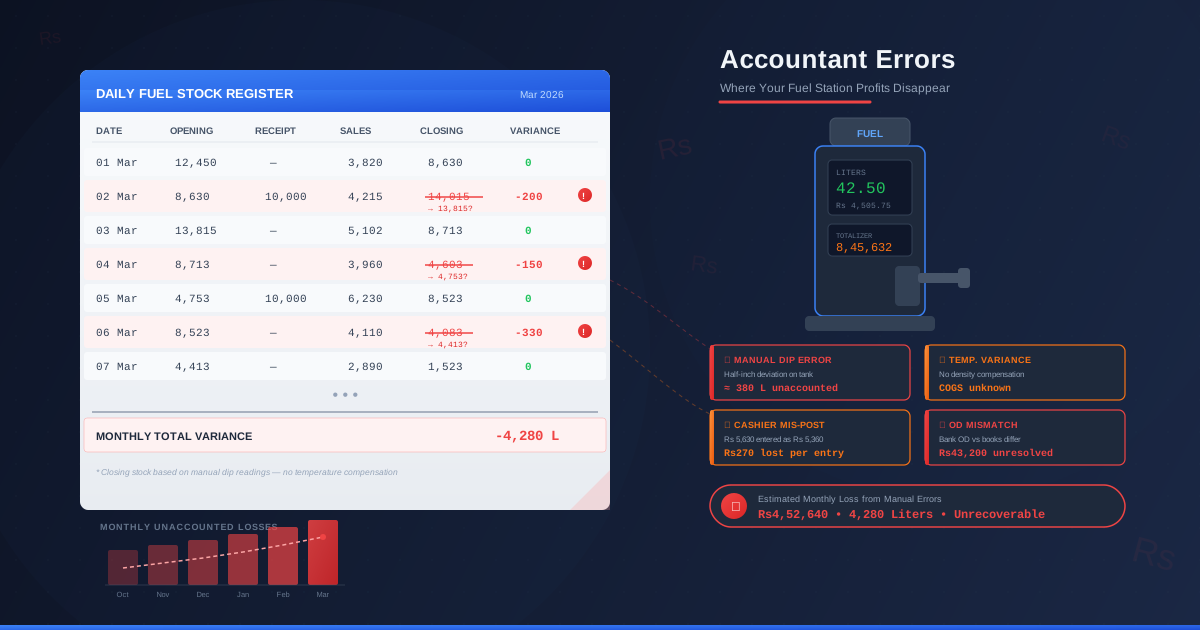
From the outside, a petrol pump looks like one of the simplest cash businesses you can run. Fuel goes in, fuel goes out, money lands in the drawer.
But step inside the manager’s office at month-end and the story falls apart. The stock register never matches the sales register. The bank overdraft balance is off by a figure nobody can explain. And somewhere between the tanker delivery and the last nozzle click of the day, thousands of liters — and millions of rupees — have quietly vanished.
If your station still relies on a wooden dipstick, handwritten meter readings, and an Excel spreadsheet to calculate Cost of Goods Sold (COGS), you are not running a business on data. You are running it on hope.
Here is exactly where the money disappears — and why traditional bookkeeping will never catch it.
1. The Physics Problem You Cannot See: Temperature and Density
Fuel is not a solid. It is a volatile liquid that expands in heat and contracts in cold, and this single physical fact silently reshapes your profit margins every day.
Consider a routine scenario:
A tanker delivers 10,000 liters of petrol at 2:00 PM under the blazing afternoon sun. The fuel is warm, so it is expanded — you are receiving volume that is partially hot air. Your invoice says 10,000 liters. Your manual dip confirms roughly 10,000 liters. Everything looks correct.
Now that same fuel is sold through the night and into the cool early morning. The temperature has dropped. The fuel has contracted back to its true dense state. Your dispensers are now pumping out molecules that are packed tighter — meaning customers receive more energy-per-liter than what you were originally billed for.
The result? You are giving away more value than you purchased, and your dipstick has no opinion on the matter.
Without compensating for temperature and specific gravity at the time of every measurement, a manual dip can only tell you a height of liquid in a tank. It cannot tell you the true economic value of what is sitting in that tank. And that distinction is where lakhs of rupees hide every single month.
2. The Uncomfortable Truth: Manual Dips Have a 100% Error Rate
Let’s walk through what “taking a dip” actually looks like in practice.
A staff member climbs onto the service area above an underground tank — often in the dark, often in a hurry, often at the end of a long shift. They lower a wooden or metal stick into the tank, pull it back up, and try to read a wet fuel line against a printed tape measure under a phone flashlight.
Now ask yourself:
- Did the stick hit the exact geometric bottom of the tank, or did it land a centimeter to one side of the sump?
- Was the stick held perfectly vertical, or did it enter at a slight angle — adding phantom depth?
- Did the reader round the measurement up or down — and did they round it the same way last time?
- Was the tank perfectly still, or was there residual sloshing from a recent delivery or a pump running on the same line?
Each of these micro-errors sounds trivial in isolation. But fuel tanks are wide. A discrepancy of just half an inch on a standard underground tank can represent 200 to 400 liters of unaccounted fuel.
Multiply that by two dips a day, across multiple tanks, across 30 days — and you are staring at a cumulative measurement error that can easily cross 5,000 to 10,000 liters per month. That is not a rounding error. That is a second salary you are paying to nobody.
The worst part? Because these errors are random — sometimes over, sometimes under — they never show a clean pattern. Your accountant cannot isolate them. Your auditor cannot flag them. They simply dissolve into the monthly “unexplained variance” column and everyone moves on.
3. The Front-End Chaos: Cashiers, Credit Parties, and Overdraft Nightmares
The losses underground are only half the story. Above ground, at the billing counter, a completely different category of financial bleeding is happening every shift.
Mis-posted Transactions
A cashier is handling six customers in ten minutes. One pays cash but the amount is accidentally posted against a credit party’s account. Another credit sale is tagged to the wrong company ledger. A third transaction is entered with a transposed digit — 5,630 becomes 5,360 — and the 270 difference joins the growing pile of unreconciled entries.
Manual Meter Readings at Shift Change
At every shift handover, someone walks out to each dispenser, writes down the totalizer reading on a slip of paper, and hands it to the next shift. If a digit is misread, if a nozzle is skipped, or if the outgoing cashier “adjusts” a number to make their shift balance — the incoming shift inherits a corrupted starting point. And every sale recorded after that is measured against a wrong baseline.
Bank Overdraft Reconciliation
Most fuel stations operate on bank overdraft (OD) facilities tied to their oil company supply accounts. Reconciling these OD accounts requires matching every delivery, every payment, every interest charge, and every credit note — often across multiple banks and multiple product lines.
Basic accounting software — the kind designed for retail shops and general trading — treats fuel like any other SKU on a shelf. But fuel is not a box of detergent. Fuel requires a system where the inventory movement and the financial ledger update in the exact same millisecond, as a single atomic transaction. When these two sides fall out of sync — even by one entry — the entire reconciliation chain breaks, and your accounts team spends days hunting ghosts.
So Where Does That Leave You?
If you are reading this and recognizing your own operation, you are not alone. The overwhelming majority of fuel stations in the country operate exactly this way — and they accept these losses as an unavoidable “cost of doing business.”
They are wrong. These losses are not unavoidable. They are unmeasured. And there is a critical difference.
The moment you can measure every variable — temperature, density, exact dispensed volume, precise financial posting — the losses do not just shrink. For many station owners, they disappear entirely.
The Solution: Replace Guesswork with Precision
To stop the bleeding, you have to remove the human element from measurement and accounting as aggressively as possible. Manual processes do not fail because your staff are dishonest or lazy. They fail because they are asking human beings to do what only sensors and software can do reliably.
This is the exact problem Sky Petro Pulse was engineered to solve.
What Sky Petro Pulse Delivers Out of the Box
| Capability | What It Means for You |
|---|---|
| True Double-Entry Fuel Accounting | Every liter sold simultaneously updates inventory and the financial ledger. Your COGS is accurate to the transaction, not the month-end estimate. |
| Automated Bank & OD Reconciliation | Overdraft accounts, oil company credits, and bank entries reconcile in real time — not in a weekend-long spreadsheet marathon. |
| Keyboard-First Cashier Interface | Cashiers tab through fields without touching a mouse. Entry speed goes up, mis-postings go down, and shift closings take minutes instead of an hour. |
| Live Multi-Device Reporting | Owners and managers view real-time dashboards from any phone, tablet, or laptop — whether you are on-site or across the country. |
| Credit Party & Fleet Management | Every credit sale is tagged, tracked, and reconciled against the correct party ledger automatically. No more month-end surprises from mis-posted accounts. |
Take It Further: Optional On-Demand Hardware Automation
For pump owners who want absolute zero blind spots, Sky Petro Pulse seamlessly integrates with a specialized hardware automation package — available on demand and installed by our certified partners.
When you add hardware to the software, you unlock:
- 🔬 Automated Tank Monitoring — Precision sensors deliver real-time dip readings, continuous temperature compensation, and specific gravity tracking directly into your Sky Petro Pulse dashboard. No more climbing on tanks. No more guessing.
- ⛽ Nozzle-Level Dispenser Integration — Every dispenser talks directly to the ERP. Totalizer readings are captured electronically at every transaction. Shift-change meter readings become automatic, tamper-evident, and audit-ready.
- 📊 Variance Alerts — The system continuously compares expected stock (based on sales) against actual stock (based on sensors). Any deviation beyond your set threshold triggers an instant alert — before the loss compounds.
The software alone eliminates your accounting blind spots. The software plus hardware eliminates your physical blind spots. Together, they give you a fuel station where every liter and every rupee is accounted for — automatically, continuously, and accurately.
Stop Accepting “Unexplained Variance” as Normal
Every month you operate on manual systems, you are funding losses you cannot see with profits you have already earned. The technology to stop it exists. It is proven. And it is purpose-built for the exact operational reality of a fuel station — not adapted from generic retail software.
You do not have to keep losing money to physics, to measurement error, and to manual entry mistakes.
👉 Request a free demo of Sky Petro Pulse and let the Sky Soft team show you exactly where your station is losing — and how quickly you can stop it.
Have questions about the optional hardware integrations? Talk to our team directly — we will walk you through sensor options, installation, and ROI timelines specific to your station size and setup.